
From the Milab archive
VIP-50
Multi-pattern studio condenser microphone
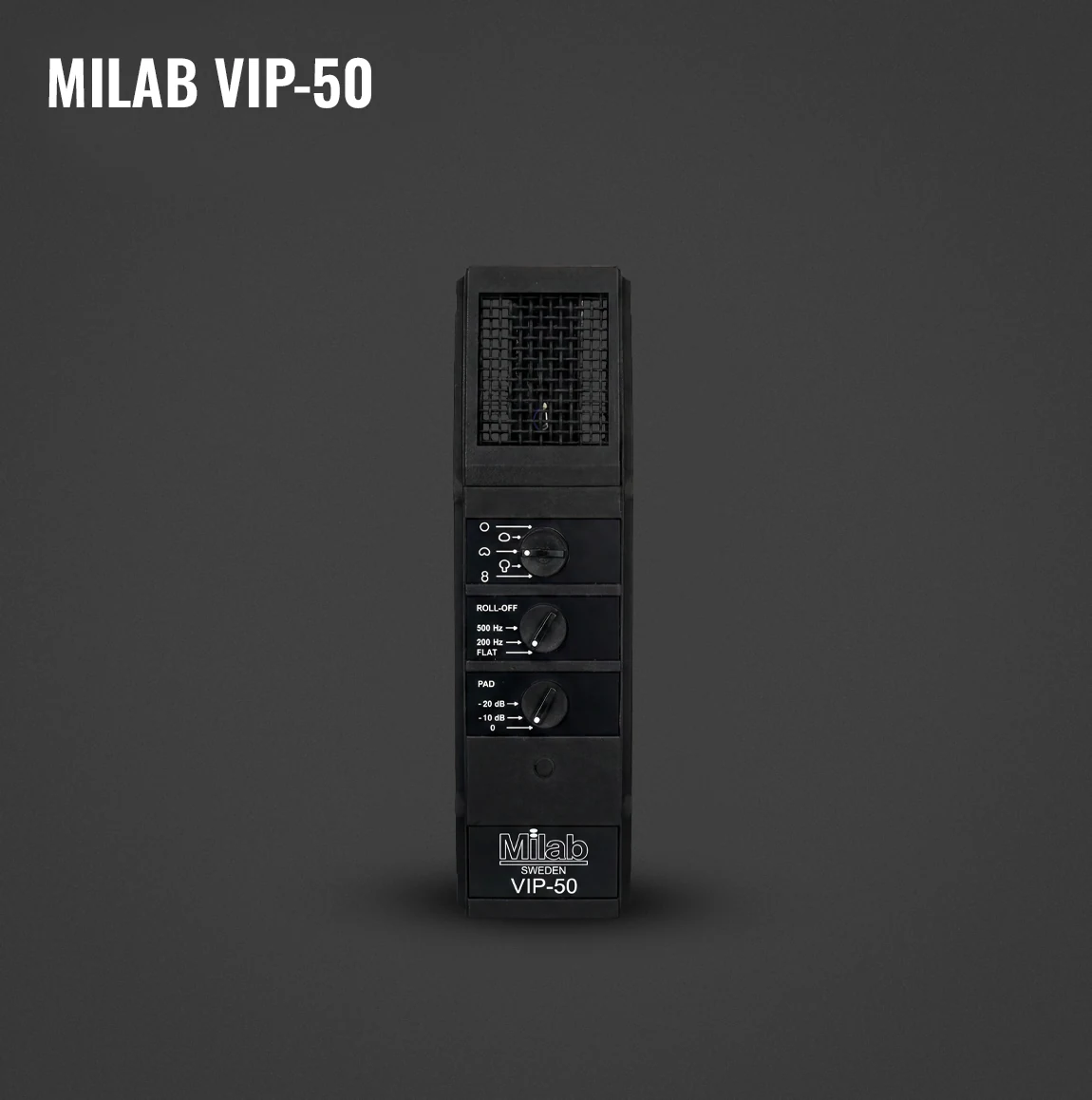
Developed in the mid-1980s around Milab’s rectangular 2700 capsule, the VIP-50 became a distinctive studio vocal microphone. Its transformerless design combines a large dual membrane with shock-absorbing capsule suspension.
Five switchable polar patterns, two high-pass filter settings and two attenuation pads give the VIP-50 a wide range of recording options.
Legacy model · No longer in production
In the studio
Five patterns. One familiar shape.
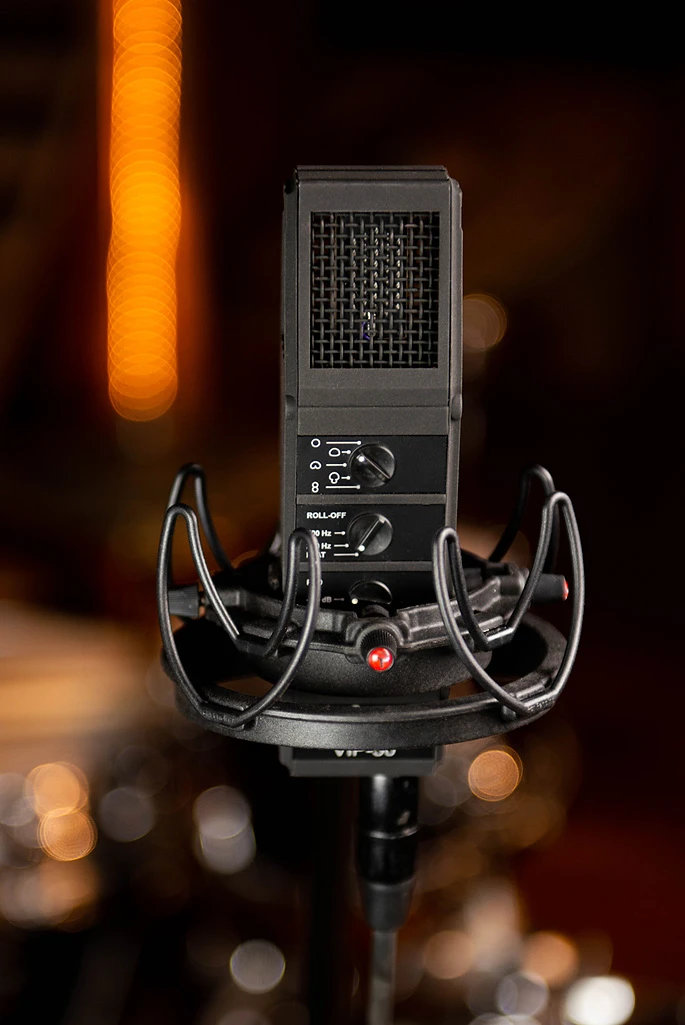
Cardioid, wide cardioid, hypercardioid, figure-eight and omnidirectional patterns are selected on the front of the microphone. Separate switches control the 200/500 Hz high-pass filters and −10/−20 dB attenuation.
The 2021 guide describes the VIP-50 as a stand-mounted microphone, used in its shockmount with the Milab logo facing the sound source for directional recording.
Technical archive
Specifications
Values below follow the original brochure available here. That edition lists 112/122/132 dB maximum SPL; the later 2021 guide lists 118/128/138 dB. These archive editions should not be treated as identical specifications.
- Microphone type
- Transformerless condenser
- Capsule
- Rectangular large dual membrane
- Polar patterns
- Cardioid, wide cardioid, hypercardioid, figure-eight, omnidirectional
- Frequency response
- 20–20,000 Hz
- Switchable high-pass filters
- 200 / 500 Hz
- Switchable pre-attenuation
- −10 / −20 dB
- Maximum SPL (1% THD at 1 kHz)
- 112 dB; 122 / 132 dB with −10 / −20 dB pad
- Sensitivity at 1 kHz
- 14 mV/Pa ±1 dB
- A-weighted noise level (IEC 179-A)
- ≤19 dB
- Power supply
- 48 V ±4 V phantom
- Current consumption
- 3.5 mA
- Output impedance
- <200 Ω
- Minimum load impedance
- 1 kΩ
- Connection
- 3-pin XLR
- Length × width × maximum depth
- 170 × 47 × 50 mm
- Net weight
- 400 g
- Article number
- 1111
Original documentation
Downloads & support
Archive editions. Contact details, accessories and service terms inside these documents reflect their original publication.
Have a VIP-50?
For questions about an existing microphone, contact Milab with its model and serial number.
Contact Milab